Mirce mechanics
“A theory can be proved by experiment;
but no path leads from experiment to
the birth of a theory." Albert Einstein
Motion is one of the most challenging concepts of science, as it covers the waving motion of atoms and molecules and the movement of planets, and beyond.
Since the earliest years of science the only idea of motion imagined was that of the continuous motion of macroscopic material bodies through time, based on forces, energy, and momentum – hence the creation of classical mechanics.
As the science progressed, the need for describing the motion of electricity arose. Initially, attempts were made to view electricity as a liquid flowing through the wires and apply classical mechanics. However, the motion of electrical current, from negative to positive terminals, by slow drifting of individual electrons while the electric field propagates through the circuit near the speed of light, required a new way of description. Even bigger challenge was to describe the motion of matter and light at atomic and subatomic scales govern by the quantised energy levels of electrons - hence, the creation of quantum mechanics.
After decades of experiencing and systematically studying the continuous motion of machines through in-service reality, Dr Knezevic concluded that the new body of knowledge is needed for accurate prediction of their in-service performance – hence, the creation of Mirce mechanics.
Observed motions of a machine through in-service reality, based on the premises of Mirce philosophy, have shown that no two machine, of the same type, exhibit identical pattern. The reason for this is the fact that the motion of machines through in-service reality is characterised by uncertainty, discontinuity, irreversibility, separability and dependence of time, location and human actions. Thus, the mathematical framework for the accurate prediction of the motion of a machine type through in-service reality must be treated probabilistically.
The laws of probability are just as rigorous as other mathematical laws. However, they do have specific features that delineate domains of application. The unique nature of the probabilistic behaviour is due to the complexity of physical processes, which cannot be studied or understood in all of its intricacy. Such inability takes its toll, as it is only possible to predict with certainty the expected behaviour of a machine type, rather than any individual copy of it.
A mathematical formulation of any phenomena can be addressed only if it is fully defined. Thus, in accordance to the premises of Mirce philosophy, Dr Knezevic has formulated the following axioms of Mirce mechanics:
Axiom 1: A machine enters in-service reality in the positive state.
Axiom 2: A machine stays in a given state until compelled to change it by any imposed action whatsoever.
Axiom 3: A machine experiences in-service events with probabilistic regularity.
Axiom 4: A machine leaves in-service reality in the negative state.
These axioms are the bedrock for all predictions in Mirce mechanics. Also, they limit its applications as they do not cover all aspects of a machine in-service reality, like: marketing, insurance, competitiveness, safety and many others.
In Mirce mechanics a probabilistic prediction of the motion of a machine type through in-service reality in respect to the in-service time is based on the framework of the irreversible sequence of occurrences of positive and negative in-service events. These events are described by the following convolution integral functions:
- Positive Function, Oi(t), which defines the probability that the cumulative time to the ith sequential positive event will take place before or at instant of in-service time t and Oi(t) is equivalent function for the ith sequential positive event.
- Negative Function, Fi(t), which defines the probability that the cumulative time to the ith sequential negative event, TNEi, will take place before or at instant of in-service time t and Fi(t) is equivalent function for the ith sequential negative event.
The first two equations below describe the probabilistic motion of a machine through in-service reality in respect to in-service time. 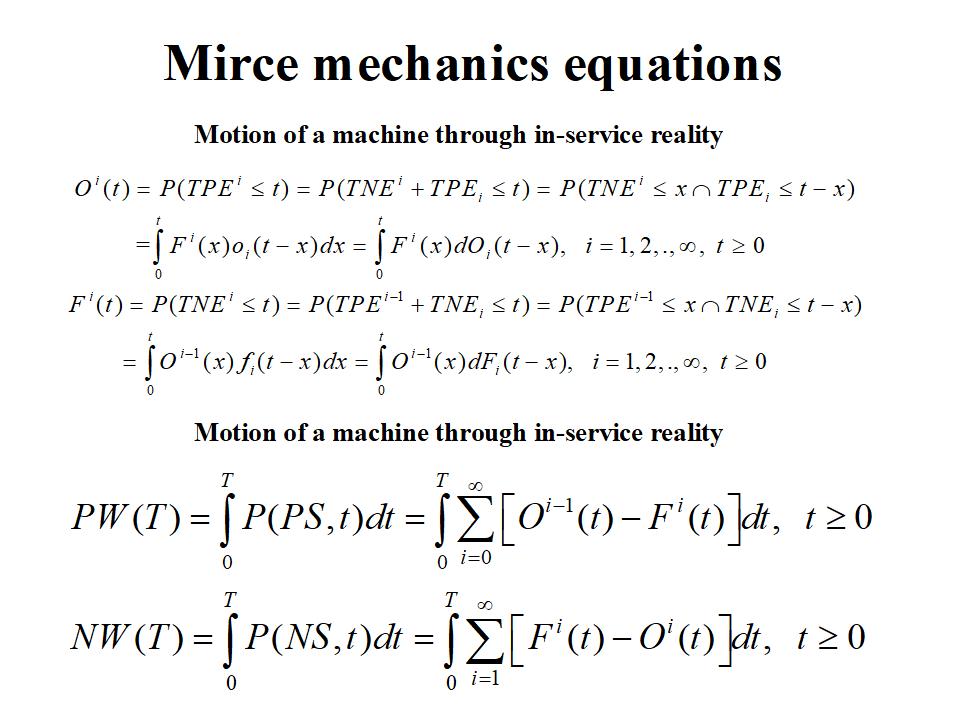
Finally, it becomes possible to quantitatively predict the expected measurable in-service performance of a machine by making use of the last two equations:
- where, PW(T) is the amount of the positive work expected to be done by a machine during the stated interval of in-service time T,
- where, NW(T) is the amount of the negative work expected to be done on a machine during the stated interval of in-service time T,
In summary, the fundamental equations of the Mirce mechanics, presented above, form a mathematical framework for quantitative prediction of the motion of a machine type through in-service reality and corresponding in-service performance.
It is necessary to stress that Mirce mechanics equations do not deal with the causing mechanisms of the motion of machine through in-service reality, only with measurable quantities of consequential in-service performance.
Source: Knezevic, J., The Origin of MIRCE Science, pp. 232, MIRCE Science, Exeter, UK, 2017, ISBN 978-1-904848-06-6