Mirce science: Research
“The machine does not isolate man
from the great problems of nature,
but plunges him more deeply into
them.” A. de Saint Exupery, 1939
Fully aware that the accurate predictions of the in-service performance of a future machine cannot be improved by doing better statistics on the past data, Dr Knezevic systematically collected the physical evidence about the occurrences of in-service events throughout in-service lives for variety of machines. Having obtained the “physical evidence” of the observed events of a machine in-service reality the author set up a very detailed research programme to understand their causing mechanisms, which represented a real challenge. Answers to the questions “what is the real cause of say, fatigue, the wind direction change, sun-cups formation on the blue ice runway, faulty weld, bird strike, perished rubber, corrosion, maintenance induced error, shark bites, carburettor icing and so forth have to be provided. Without known answers to those questions the accurate predictions of their future in-service performance is not possible, and without ability to predict the future, the use of the word science becomes inappropriate.
To understand the mechanisms that generate negative in-service events analysis of over tens of thousands of components, modules, assemblies and machines in aerospace, transportation, motor-sport, nuclear, communication and other industries, had been studied at the Mirce Akademy. As it has a profound impact on all aspects of the in-service life on any machine numerous research studies have been performed by the Master and Doctoral students of the Mirce Akademy with aim to understand the physical mechanisms that caused their occurrences.
According to Mirce philosophy all physical phenomena that cause the motion of a machine from the positive to negative in-service states are known as negative in-service events. Mechanisms that generate negative in-service events belong to the following three categories:
- Component-internal actions that consist of:
Inherent mechanisms – imposed into components prior to their introduction to in-service reality, associated with the design, manufacturing, handling, transportation, maintenance, storage and similar actions.
Discrete mechanisms – where acting stresses generated by mechanical, electrical, thermal, radiation, chemical and other type of energy exceed that strength of components and machines subjected, resulting from phenomena like foreign object damage (birds, hail, rain, snow), lightening, abuse by operators, maintenance errors and similar
Cumulative mechanisms – where acting processes are an inevitable part of the components in-service reality resulting from natural decay processes such as: corrosion, fatigue, creep, wear and similar. - Component-external actions, which are originated by:
Environmental mechanisms – that cause discrete overload, like foreign object damage; birds strike (domestic and wild animals), weather (hail, rain, snow, lightening, solar radiation, etc.,) and so forth.
Human activities:
Errors in use and abuse by:
Users: in the rolls as: operators, (pilots, driver and other users), maintainers (maintenance induced errors) and logistics support personnel (bogus parts, shelf life, etc.)
Rules that are related to organisational policies, legal requirements, national and international, best practices or any other human imposed functionability related actions (scheduled and condition based maintenance tasks). - Machine-internal actions: resulting from processes that are taking place within a machine, like a change from passive to active state for certain components and modules, a change of in-service states of some of its constituent components that impact the in-service state of a machine.
- Machine-external actions: which are generated by:
Discrete environmental mechanisms related to weather (hail, rain, snow, lightening, volcanic eruptions, wind, fog, solar radiation, etc.) and other causes that impact the in-service state a machine.
Human activities:
Errors, which are related to the phenomena of use and abuse by: operators, maintainers or supply chain personnel.
Rules, which are related to organisational policies, legal requirements, national and international, best practices or any other human imposed functionability actions that cause the occurrence of negative in-service event of a machine.
All physical mechanisms that cause the motion of a machine from the negative to positive in-service states are named as positive actions. Mechanisms that generate positive events belong to the following categories: - Servicing: replenishment of consumable fluids, energy, belts, etc.
- Lubrication: installing or replenishing lubricant.
- General visual inspection: performed to detect obvious unsatisfactory conditions. It may require the removal of panels and access doors, work stands, ladders, and may be required to gain access.
- Detailed visual inspection: consists of intensive visual search for evidence of any irregularity. Inspection aids, like mirrors, special lighting, hand lens, boroscopes, etc. are usually required. Surface cleaning may be required, as well as elaborate access procedure.
- Special visual inspection: an intensive examination of specific area using special inspection equipment such as radiography, thermography, dye penetrant, eddies current, high power magnification or other NDT. Elaborate access and detailed disassembly may be required.
- Check: a qualitative or quantitative assessment of function.
- Examination: a quantitative assessment of one/more functions on an item to determine whether it performs within acceptable limits.
- Operational: a qualitative assessment to determine whether an item is fulfilling its intended function. It does not require quantitative tolerances.
- Restoration: perform to return an item to a specific standard. This may involve cleaning, repair, replacement or overhaul.
- Discard: removal of an item from service.
All of the above listed mechanisms of the motion of machines through positive and negative in-service states are observable physical actions that generate corresponding in-service events. These mechanisms must be fully understood of accurate predictions of expected in-service performance of a machine is to be made by making use of Mirce mechanics equation. It is essential to understand that mathematics does not deal with a physical reality, only its quantity.
Based on the real life observations conducted over several decades the author concluded that, from Mirce science point of view, the physical scale within which a full understanding of causing mechanisms should be based within the following scale [1]:
- the “bottom end” of the physical reality, which is at the level of the system atom that exists in the physical region of 10-10 of a metre,
- the “top end” of the physical reality, which is at the level of the solar system that stretches in the physical scale around 10+10 of a metre.
This range is the minimum sufficient scale of the in-service reality that enables the understanding of the relationships between causing actions and observed in-service events to obtain enough information for the accurate predictions of the motion of machines through in-service reality to be made, as shown below.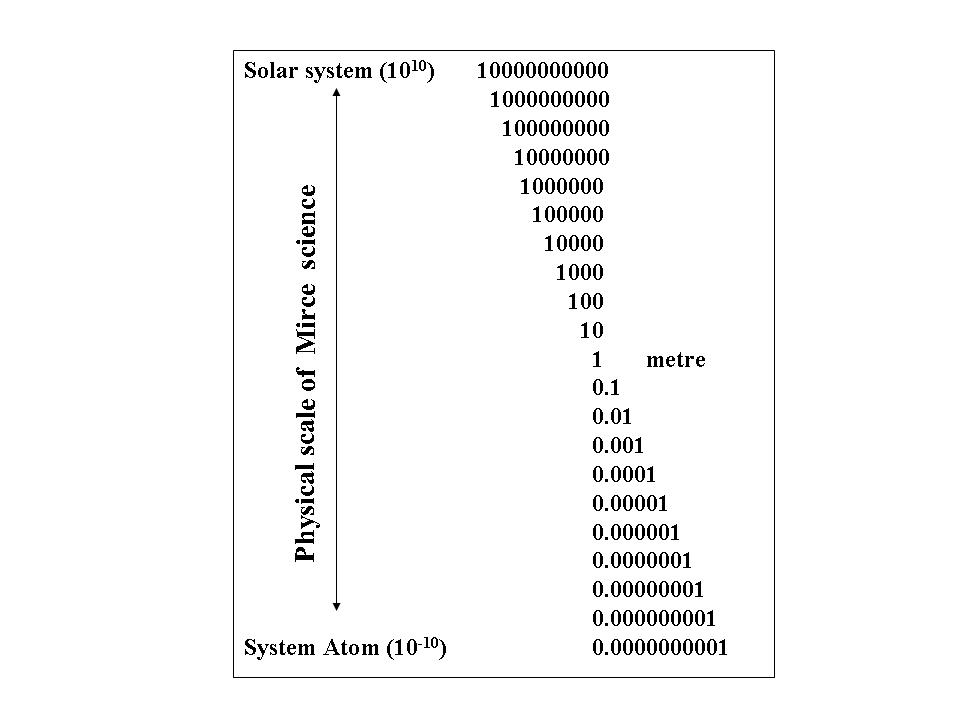 In summary, the motion of machines through in-service reality is facilitated by the conversions of the following forms of energy: heat, light, electrical, magnetic, chemical, atomic, mechanical and sound, defined by the laws of thermodynamics, caused by natural phenomena in conjurations with applied human actions.
Source: Knezevic, J., The Origin of MIRCE Science, pp. 232, MIRCE Science, Exeter, UK, 2017, ISBN 978-1-904848-06-6